
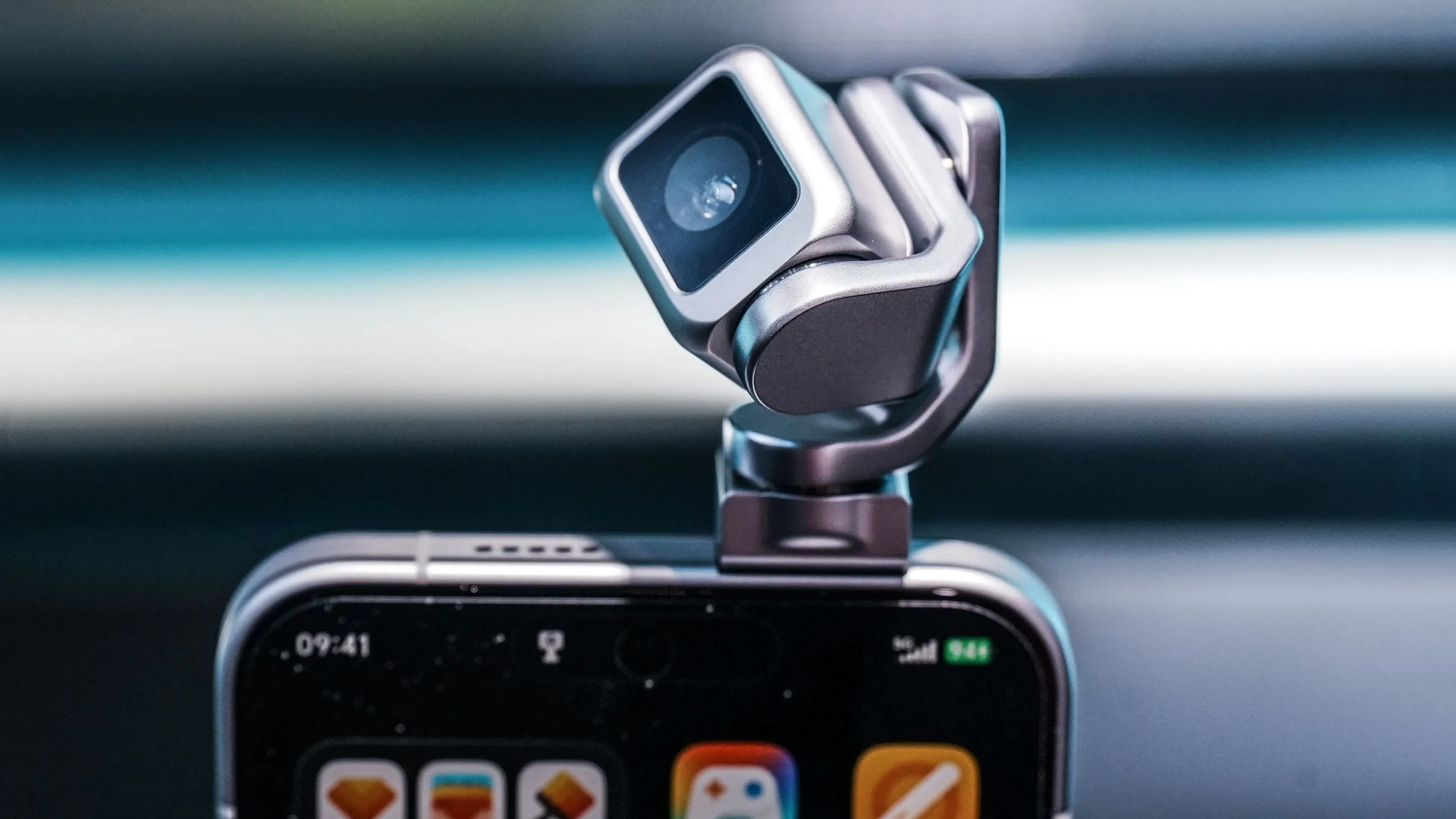
The obvious way to judge Honor’s Robot Phone is to ask whether it can replace a DJI Osmo Pocket. That may also be the least useful question.
Yes, the resemblance is hard to miss. A motorized camera rises from the top of the handset, stabilizes video and follows a subject around the room. But shrinking a pocket gimbal into a phone is only the visible trick. The more consequential change is that the phone can now move its own point of view.
That turns the Robot Phone from a camera with better stabilization into a device that can decide where to look. The megapixel count is impressive; the shift in the relationship between user and phone is more interesting.
Start with the hardware, then look past it
According to the original report, Honor’s gimbal carries a 200MP camera with a 1/1.28-inch sensor and an f/1.6 lens. A periscope camera is also planned, using a 1/1.4-inch sensor and an f/2.6 aperture, though Honor has not yet detailed its focal length.
The retractable assembly is built around a 2.6g micro motor. It can stabilize footage, predict movement and track a subject after a double tap. When filming is over, the mechanism folds back into the rear camera housing.
On paper, that makes the Robot Phone sound like a conventional flagship plus a miniature film crew. In practice, the 200MP label is not what will decide whether the idea works. A large sensor cannot make a moving mechanism pocket-proof, and AI tracking is only helpful when it understands when not to track.
The Robot Phone’s best feature may be its ability to move. Its hardest problem will be knowing when to stay still.
A mechanical upgrade is also a deliberate regression
Smartphone design has spent years removing moving parts. Honor is putting one back in, complete with a motor, joints and a cover that must open and close repeatedly. That is a bold advance in camera control and, viewed from the opposite direction, a new collection of possible failure points.
Honor says its compact four-degrees-of-freedom system enables three-axis stabilization, 360-degree subject tracking and automatically centered video calls. The company’s official Robot Phone material also shows the camera nodding, shaking its head and moving to music.
Those demonstrations give the hardware personality, but buyers will eventually need less theatrical answers. How does it react to a drop while the camera is extended? Can dust reach the joints? What happens when a case blocks the arm? How expensive is the module to repair? Honor has not fully answered those questions, so durability claims should wait for the commercial hardware.
This is the useful reverse test: do not ask what the moving camera can add until Honor explains what the phone had to give up.
ARRI matters, but not as a logo
Honor’s collaboration with cinema-camera specialist ARRI could be more valuable than the gimbal itself. The announced toolkit includes ARRI-influenced color science, Log C capture, LUT support and a dedicated cinema mode. Those features are intended to preserve more image information and give creators greater control in post-production.
Still, a cinema badge does not automatically produce cinematic footage. Color response, highlight roll-off, rolling shutter, audio and thermal limits will matter more than branding. The real win would be a consistent pipeline that makes phone footage easier to match with dedicated cameras, not simply another set of dramatic filters.
The gimbal and ARRI partnership make sense together: one controls physical movement, while the other shapes the resulting image. But both need to survive ordinary use outside a polished demo.
The launch should answer the boring questions
Honor is expected to reveal the remaining details on August 12. Pricing, availability, battery impact and repairability will tell us more about the Robot Phone than another tracking demonstration.
If Honor gets those basics right, the device could be more than an Osmo Pocket fused to an Android phone. It could establish a new interface for embodied AI, one where software does not merely respond on a screen but acts through motion.
If it gets them wrong, the Robot Phone will still be a spectacular camera demo. It just may prove that the static smartphone was boring for good reasons.